basalt
A knowledge vault that lives in any object store (a local folder, S3, MinIO or R2) with real per-reader permissions and indexes anyone can rebuild. The vault is plain markdown that Obsidian, an editor or git can open; a gatekeeper serves it as a website and over eight protocols, and every reader, person or agent, sees only what they may. One specification, one conformance corpus, three implementations: TypeScript, Rust and Python.
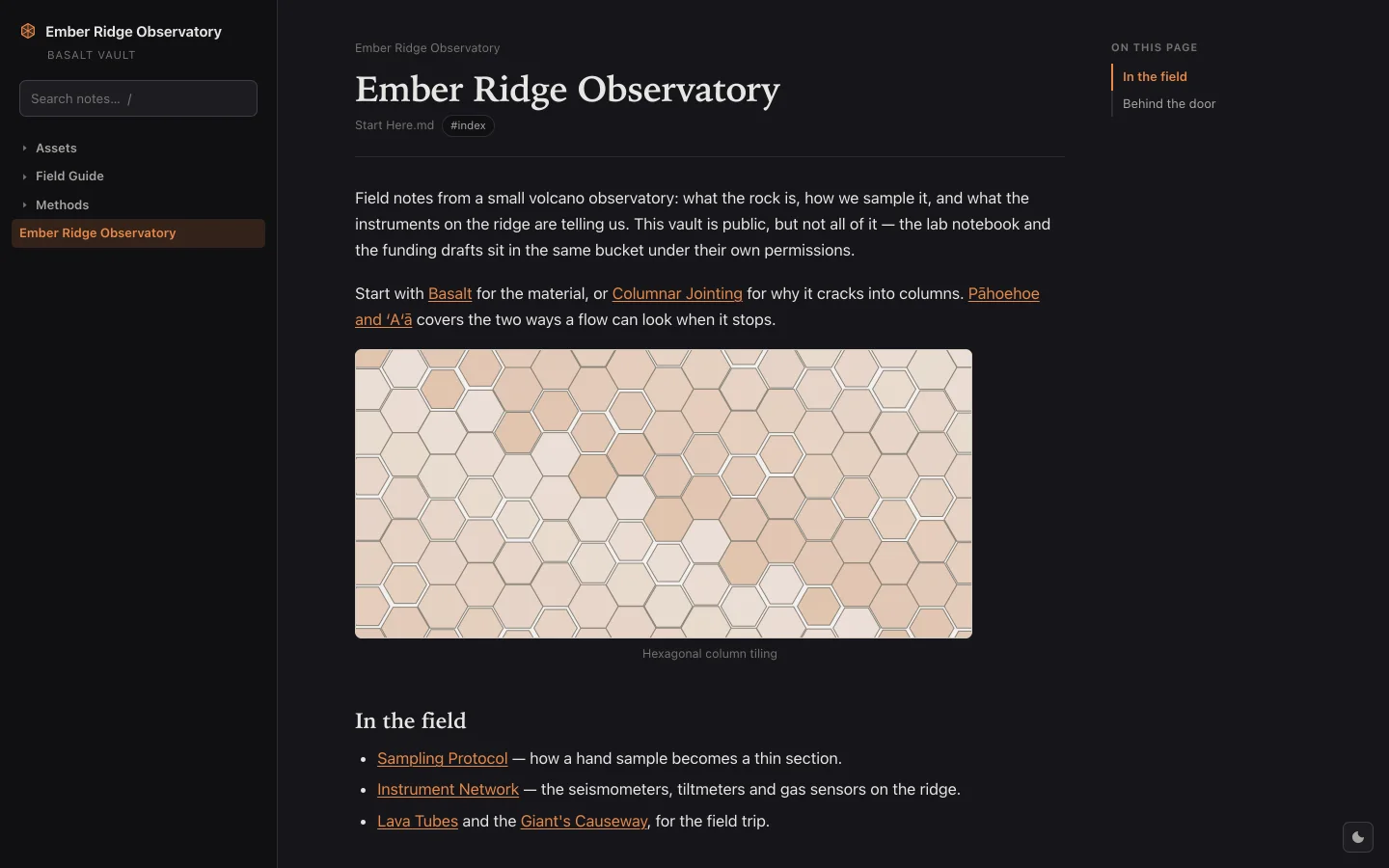 01 The publish site, as a visitor
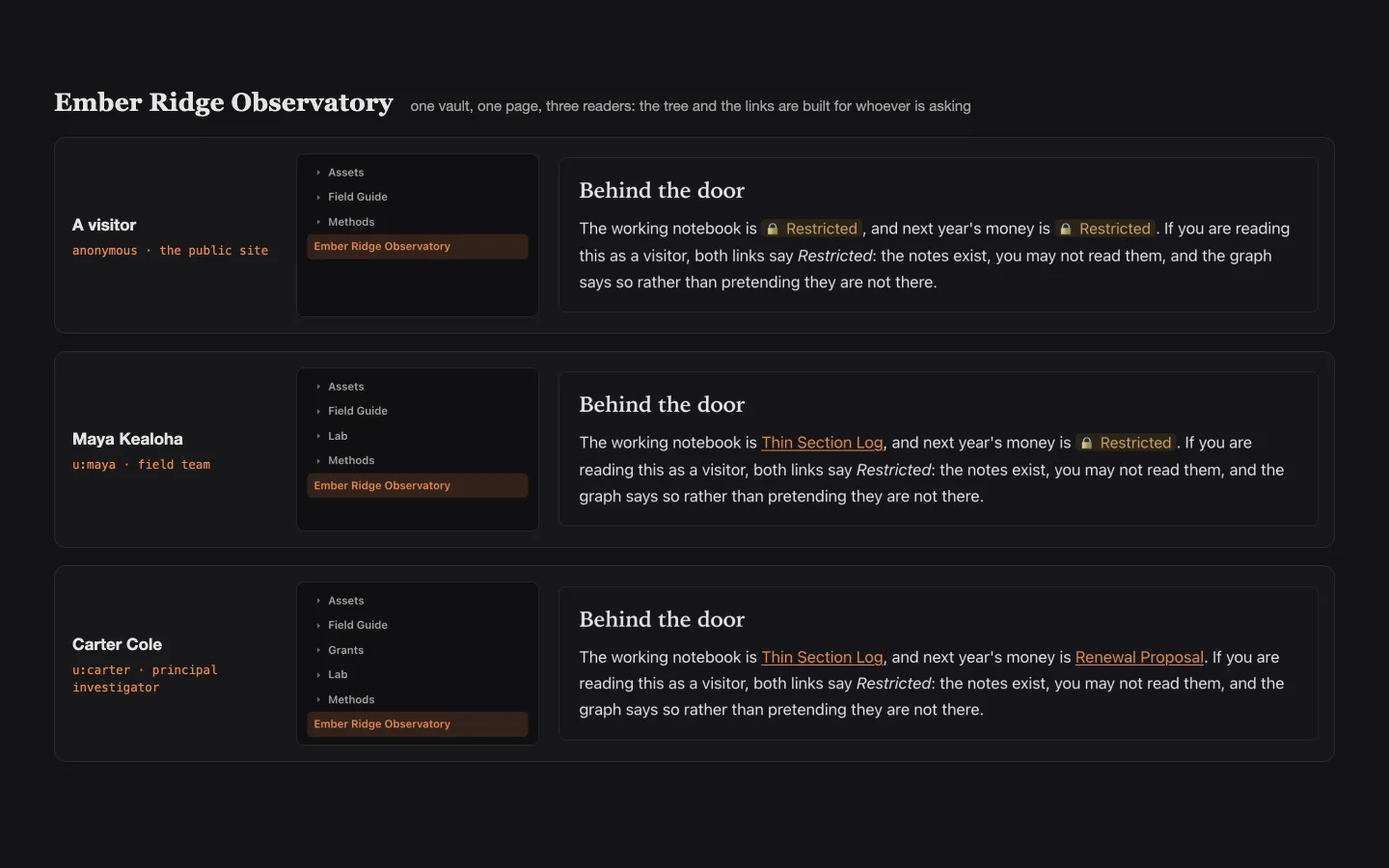 02 One page, three readers
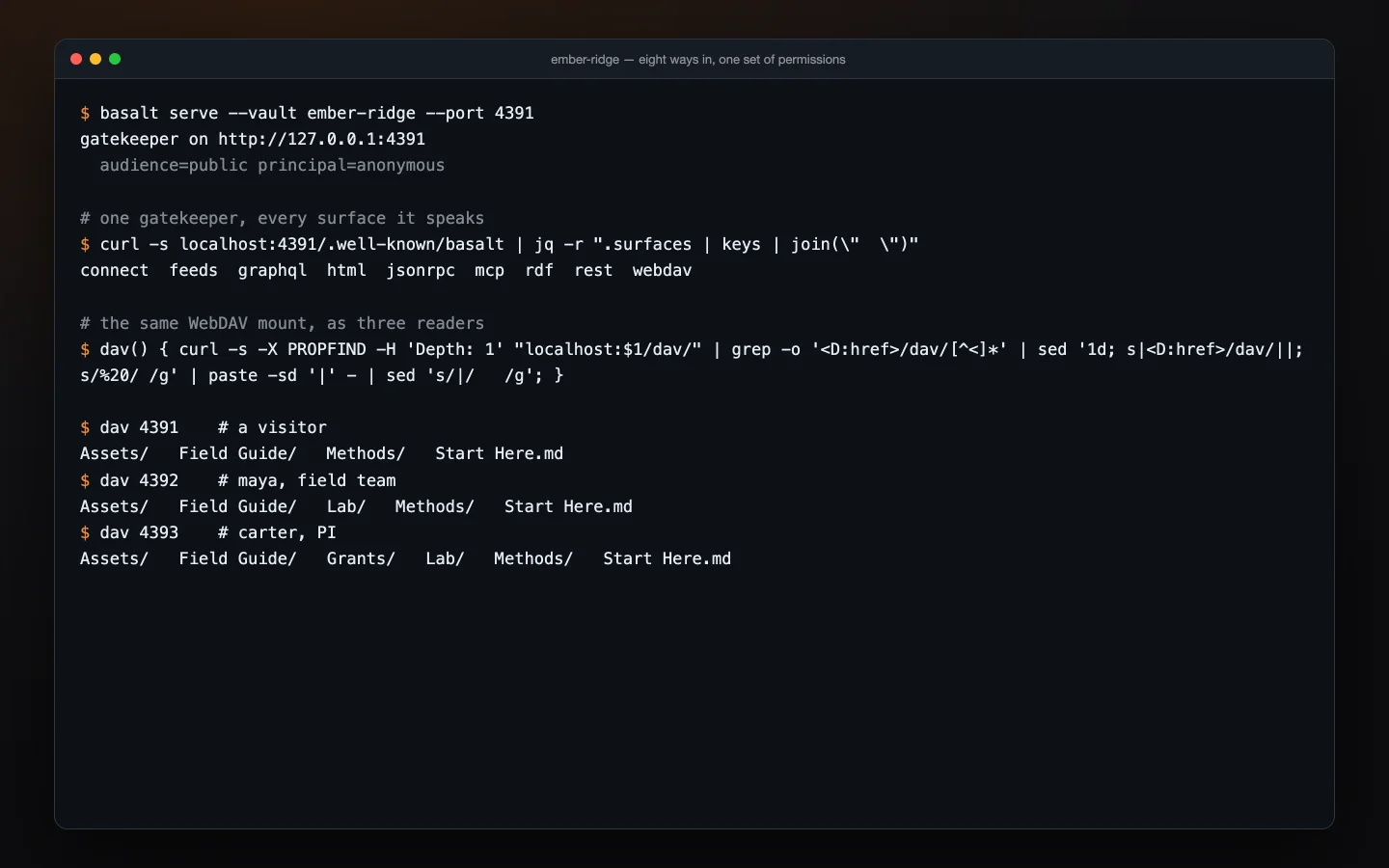 03 Eight surfaces, three WebDAV views
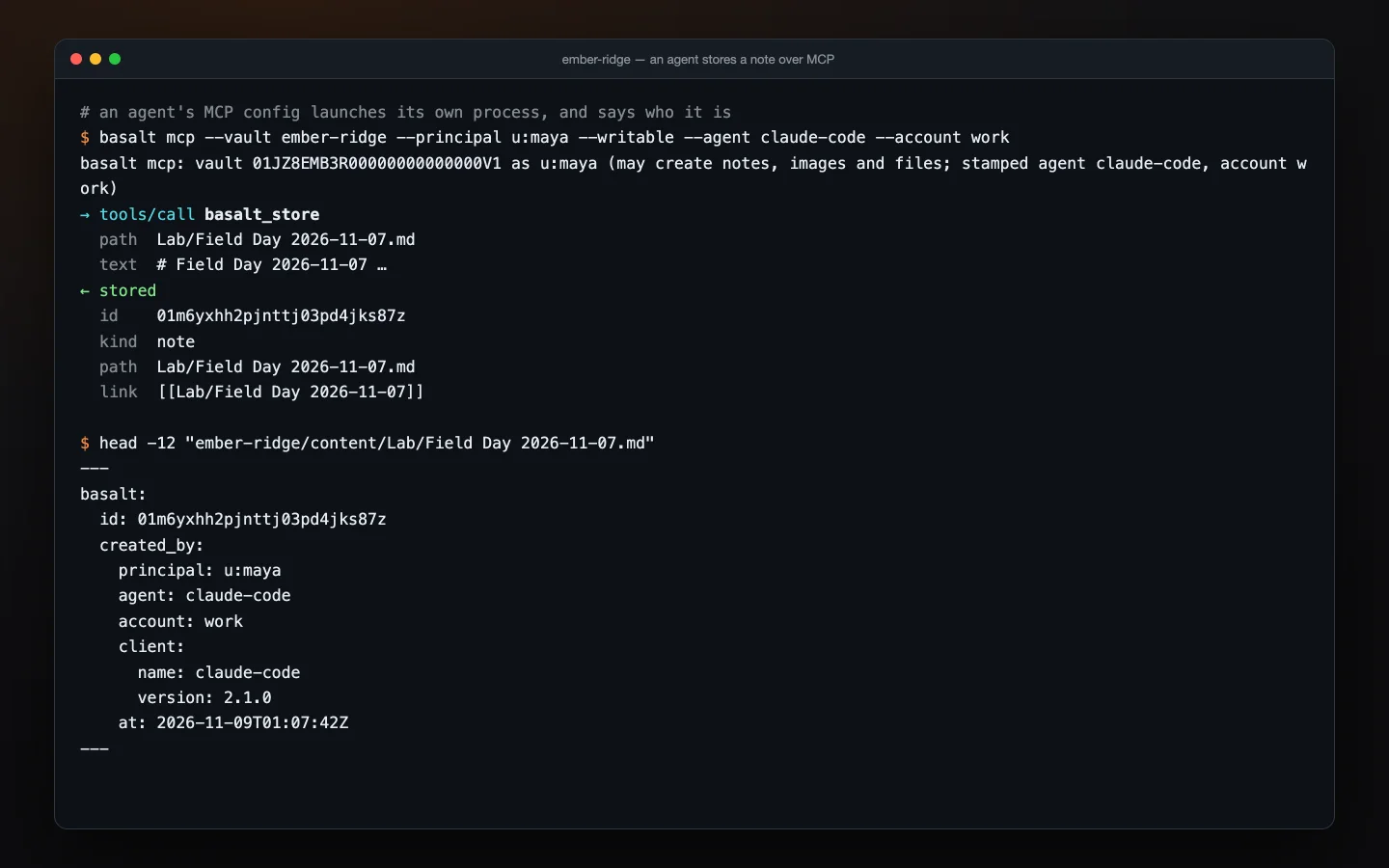 04 An agent stores a note over MCP
The idea
Basalt is built the way an open format should be: a specification anyone can implement, a language-neutral conformance corpus that decides whether they did, and three implementations held to it.
A vault is a flat set of key-to-blob pairs and nothing else. Storage has to do five things, get, put, delete, list and stat, and everything above that is content in the same key space, so a folder on disk and a bucket behave identically. Notes live at their human paths and carry their own ids in frontmatter, so the vault is a folder of markdown, readable by tools that have never heard of Basalt.
Every index is derived. Delete them all and any conforming implementation rebuilds them from the content alone, and because index generation is specified down to the byte, two implementations given the same content must write the same files. Conformance is something you check with cmp, not something you argue about.
Permissions that inherit
- NTFS-style access control: ordered allow and deny entries on folders and notes, with object- and container-inherit flags, and
protectedto stop inheritance at a folder. - Fine-grained rights, from
read,listandtraversetocreate_child,write_aclandpublish, with roles such aseditorthat bundle them. - A gatekeeper holds the only credentials to the bucket and enforces all of it, because no S3-like store can express an inherited deny.
- Every reader gets their own site: their own tree, links, backlinks, graph and search. A link to a note they cannot open stays where it is, marked Restricted, so the graph stays honest instead of quietly shrinking.
- A note that does not exist and a note you may not discover look the same: both are a 404.
basalt checkshows any principal's effective rights on any path, and which entry decided each one.
Eight ways in
One listener speaks REST with OpenAPI 3.1, GraphQL, JSON-RPC 2.0, MCP, gRPC/Connect, read-only WebDAV, Atom, RSS, sitemap and OpenSearch feeds, and JSON-LD and Turtle. Each is a translation layer with no behaviour of its own, and one test suite asks all of them the same questions and compares the answers.
The WebDAV mount is the one that surprises people. Mount it and Finder, Obsidian or rg see exactly the subset that reader may open: a filtered filesystem, while the gatekeeper keeps the bucket's credentials to itself.
Built for agents
Claude and other MCP clients read the vault through the gatekeeper, under the same permissions as anyone else. A writable session adds one tool, basalt_store, and it can only create: it never overwrites, never deletes, and refuses an inline ACL its writer could not have set.
Each new note, image or file is stamped with the principal, the agent and the account that launched the session, and on AWS with the IAM identity behind the credentials. A vault that several agents write to says which one wrote what. A model cannot name itself: the stamp comes from the session, not from the tool call.
Publishing
- The publish site renders GitHub-flavoured markdown plus Obsidian's syntax:
[[wikilinks]], embedded images and PDFs, one level of transclusion, TeX math rendered to MathML on the server, and Mermaid diagrams. basalt exportwrites a static site of only the notes that grant bothreadandpublishto anonymous, with search that runs in the browser. It rebuilds the indexes from that subset rather than copying them, because the vault's own indexes know every private title and edge.- The repository's Pages workflow ships the demo vault and fails the build if a withheld note reaches the output.
Conformance
- The protocol: seventeen sections, from the transport contract to canonical serialization and the conformance levels, plus an interoperability annex and a gRPC schema.
- The corpus: language-neutral YAML fixtures and whole vaults with their expected index output. Every implementation ships a runner, and none defines its own expectations.
- TypeScript is the reference: levels L0 to L4, every interop profile, the gatekeeper, the publish site and the static exporter.
- Rust is held to the same corpus and serves REST and MCP itself, which makes the equivalence claim cross-language.
- Python covers L0 to L4 as a library and CLI, plus optional topic search.
- In the tour, all three index the same vault and arrive at the same digest.
Stated honestly
- Every network surface is read-only. The one write is create-only; replacing and deleting wait on version history, conformance level L5, which nothing implements yet.
- The test suite runs against a local filesystem, memory and MinIO. Real S3 and R2 need credentials the repository does not carry.
- A private note is unreadable, not undiscoverable: if a public note names it, the public note has published the name.
About these pictures
Every screenshot here is Basalt serving one small vault, a volcano observatory with a public field guide, a lab notebook only the field team can open, and a grants folder only its principal investigator can, as three different readers. The terminals are real commands run against it, and the tour is built from the same captures.