// 03 HARDWARE
Jetson TX1
An NVIDIA Jetson TX1 from 2015 — 256 Maxwell CUDA cores and 4 GB of memory shared with a quad-core ARM CPU — running the Game of Life on all eleven tilings made of regular polygons. A rule counts the share of a cell's neighbours alive rather than their number, so one rule means the same thing to a triangle with three neighbours and a dodecagon with twelve. The board searched 6,820 random rules for ones that move; these are the best, alongside new rules where colour, size, shape and time change the game.
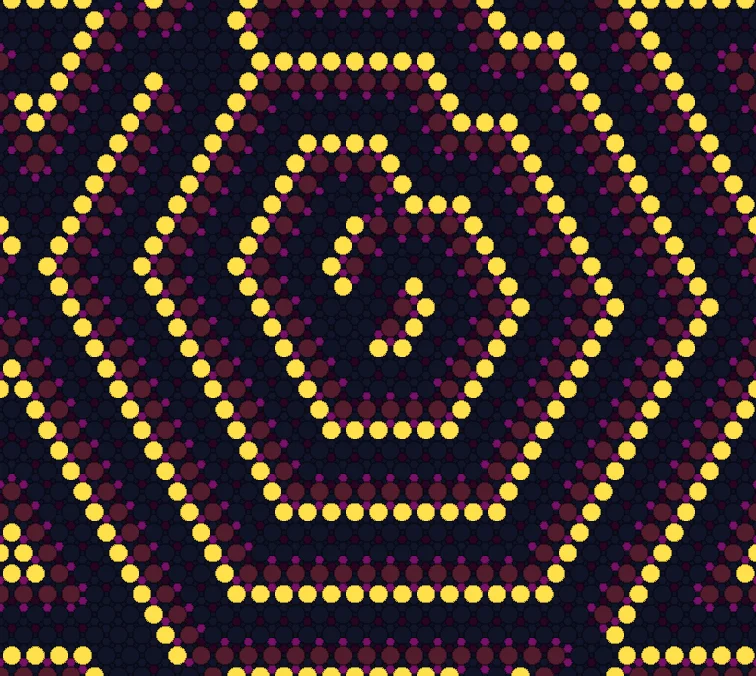 01 Dodecagon shock rings, 4.6.12
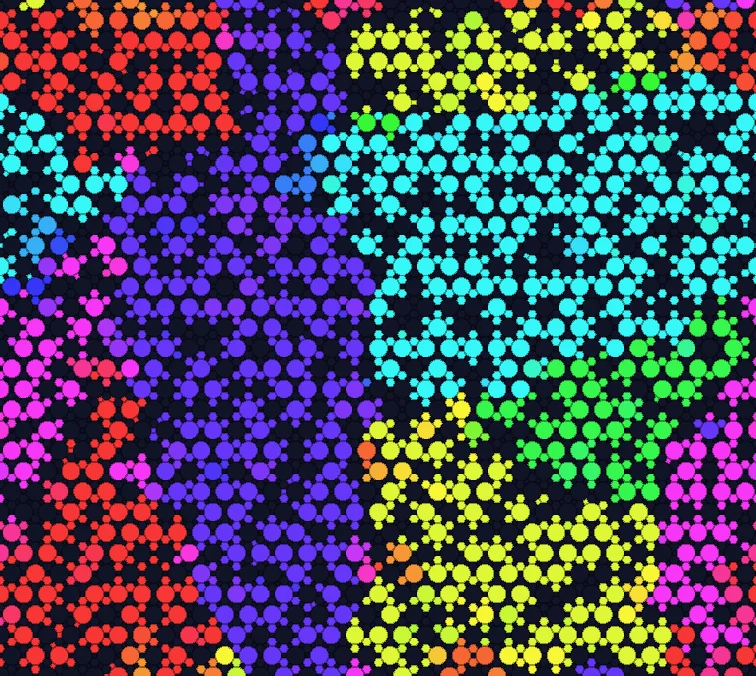 02 Colour genes: species wars
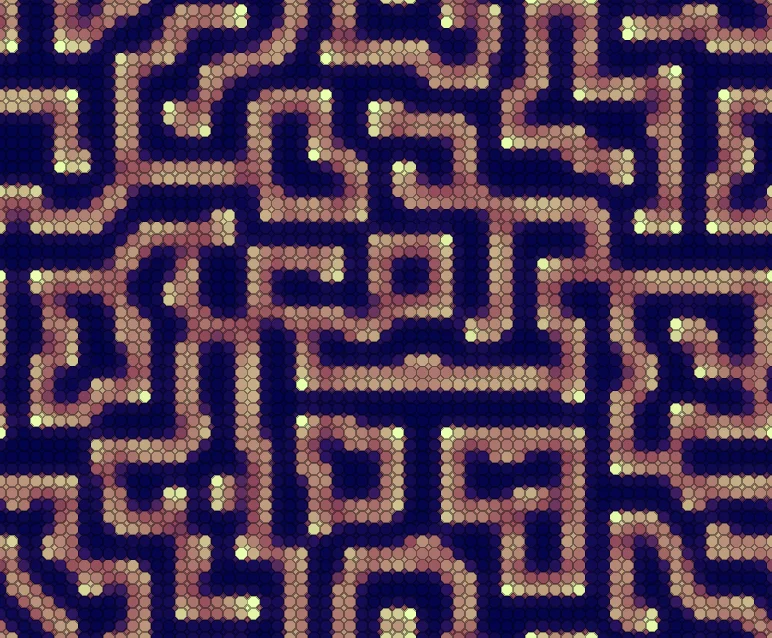 03 Turing maze, 4.8.8
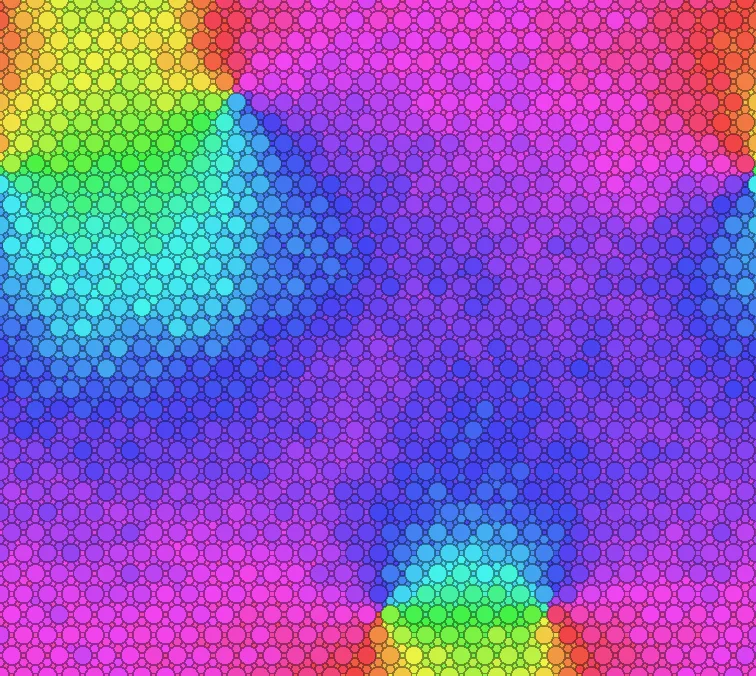 04 Kuramoto clocks, 4.6.12
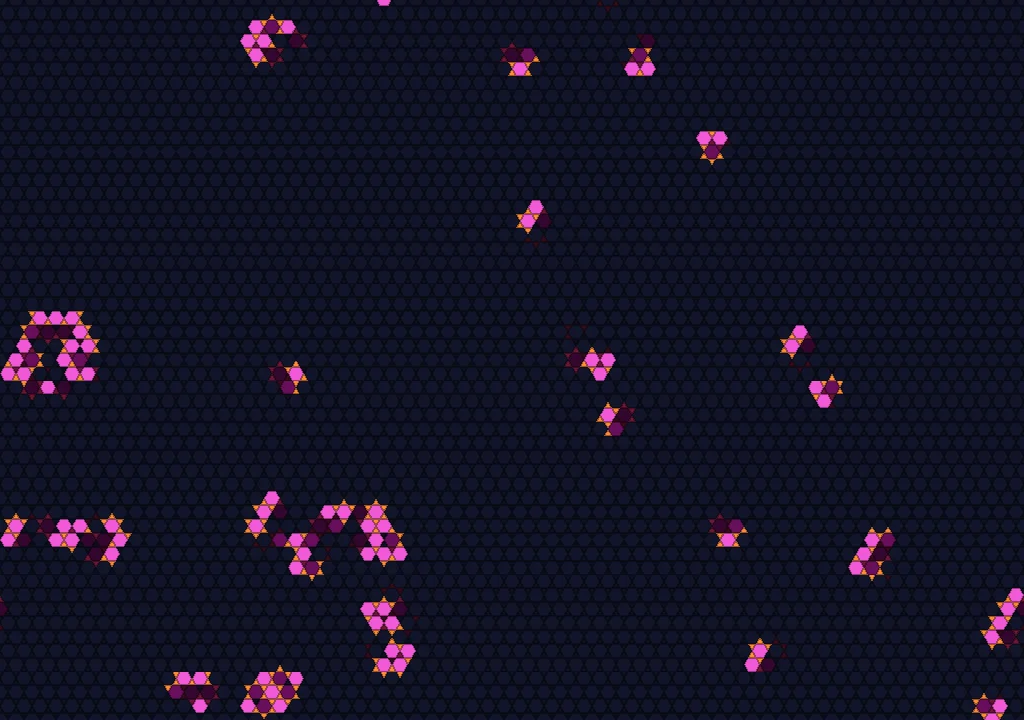 05 Kagome spaceships, 3.6.3.6
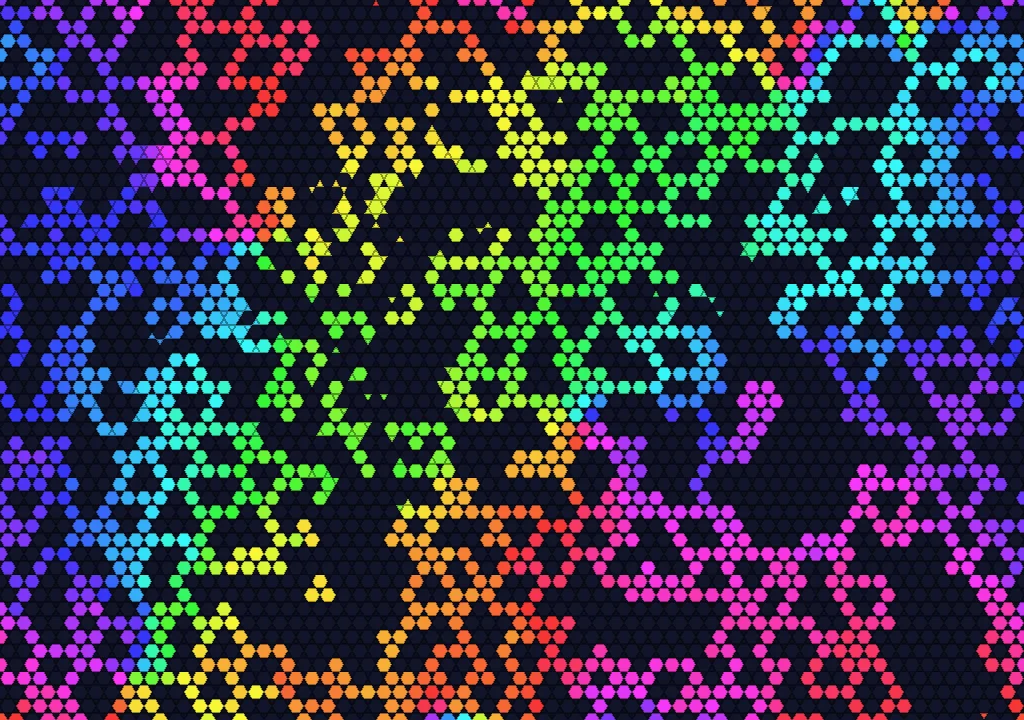 06 Colour genes: rainbow lace
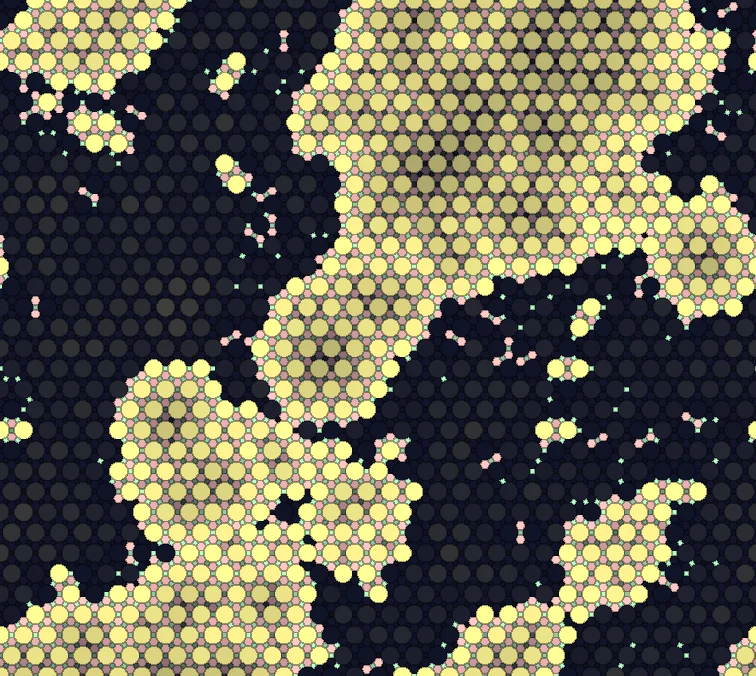 07 Firefly sync, 4.6.12
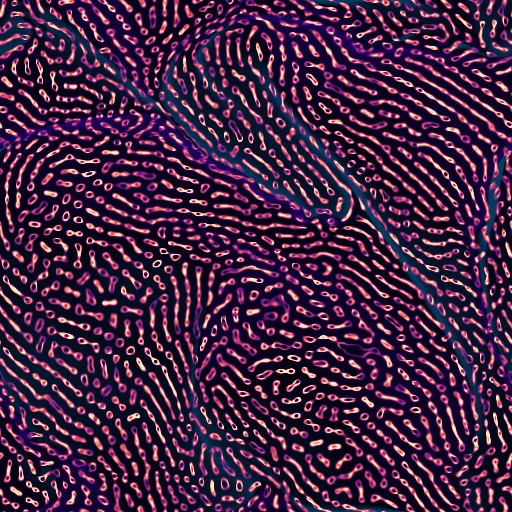 08 Lenia stirred by a fluid
The rules
Every game here is one simple rule, applied to every tile at once, step after step. The families:
- Life and its trails. Born when the share of live neighbours falls in one window, survives in another, and in the Generations variant a dying cell fades through a few resting states first. Square-row highways, kagome spaceships and dodecagon shock rings are this.
- Cyclic. Colours in a loop, like rock, paper, scissors: a cell takes the next colour once enough of its neighbours have it. Spirals, whose shape the tiling sets.
- Lenia. Life with dimmers instead of switches: each cell is a number from 0 to 1 that grows when the ring of cells around it is just full enough.
- Turing patterns. Two chemicals, one fed in and one eating it, diffusing across shared edges (Gray–Scott), into mazes, frozen spots and spots that divide.
- New ones. Colour genes, where a newborn takes its parents' average hue and only counts its own kind; three Life games in red, green and blue that eat each other; live area instead of live cells, so big polygons need a crowd; neighbours of another shape counting for and of the same shape against; hit points equal to a polygon's sides; a clock per shape; and blinking oscillators that fall into step.
- Fluid life. Lenia and Conway's own rule on a 512 × 512 grid inside a stable-fluids simulation: stirred, carried by a current, or pushing the water themselves.
How it runs
tilings.py builds each tiling as a periodic unit cell and checks it: areas, edge lengths, shared edges and 360° at every vertex. One CUDA engine, compiled for the TX1's sm_53, runs any tiling under any rule and writes PNG frames straight to video; a second runs the fluid. A random search scored 6,820 rules across the eleven tilings, a probe re-ran the promising ones looking for gliders (cells that are live now, were dead in the same place a few steps ago, and were live a little way off), and the best were filmed.
The same engine also serves them live: a small HTTP and WebSocket server on the board runs each preset someone is watching as a wrapping world, and sends each browser only the cells under its view, XOR'd against the last frame and deflated — about 0.1 to 25 KB a frame. A WebGL2 shader turns cell states back into polygons, so panning and zooming run at the display's rate. Twelve viewers get about 24 frames a second each, and forty about 15.
The explainer
The presenter is the Carter chibi from chibi-maker, lip-synced to the narration and posed scene by scene. The narration is my own voice, cloned from a fifteen-second recording by Chatterbox, the model behind ComfyUI's Voice Clone node, run on my own machine. Every clip is the board's own footage. There is a thirty-second phone cut as well.