// 01 ACTIVE SYSTEMS
carterlitics
First-party analytics, self-hosted. One collector counts every request to this site and cartercole.com, from CloudFront's own access logs: people, crawlers, AI bots, and scanners probing for /wp-login.php. One script adds page views, visits, events and JavaScript errors without a cookie. Only a visitor who clicks Accept gets a visitor ID and a session recording. It's stdlib Python on Lambda with one DynamoDB table and two S3 buckets, and it costs cents.
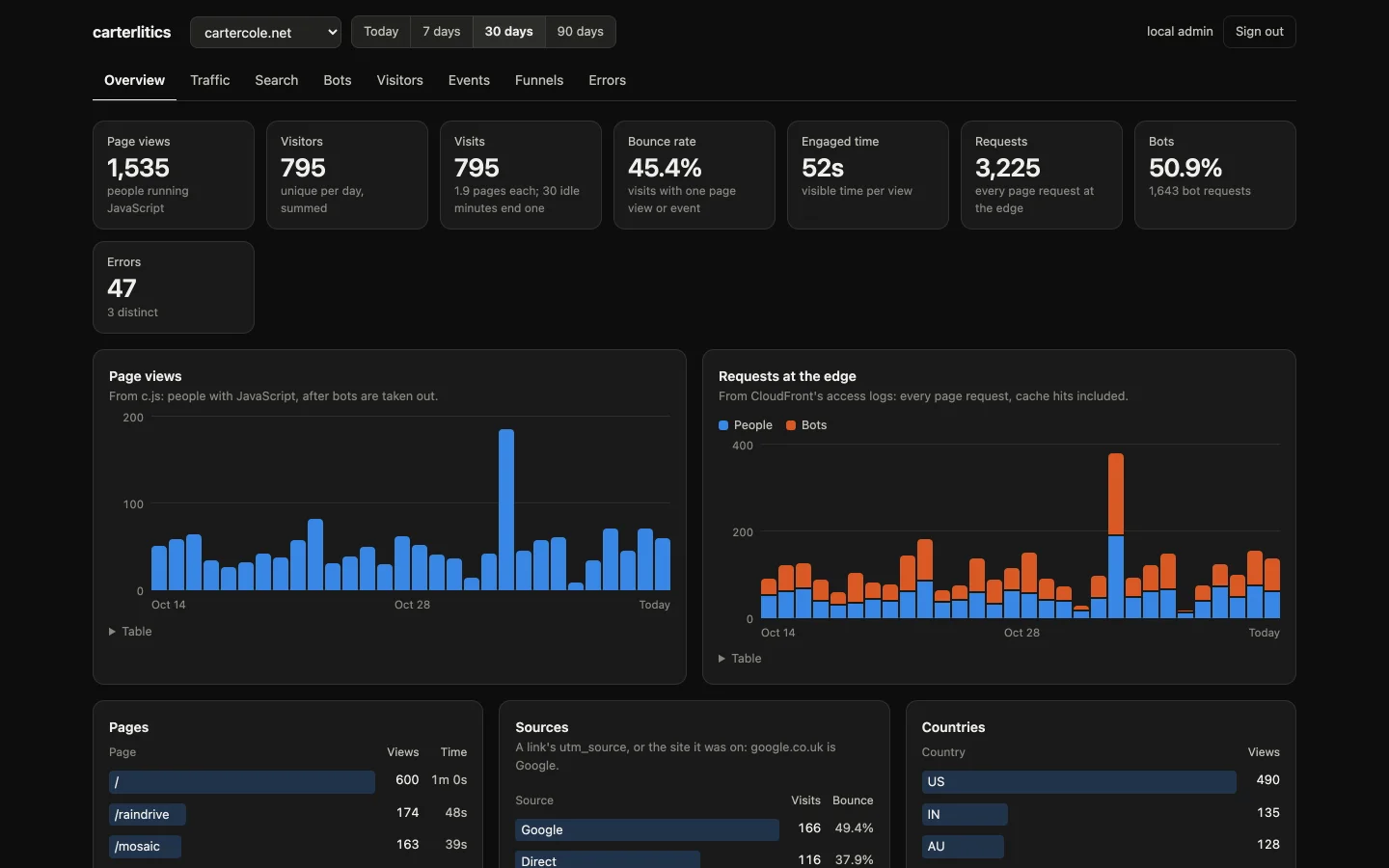 01 People and bots, counted at the edge
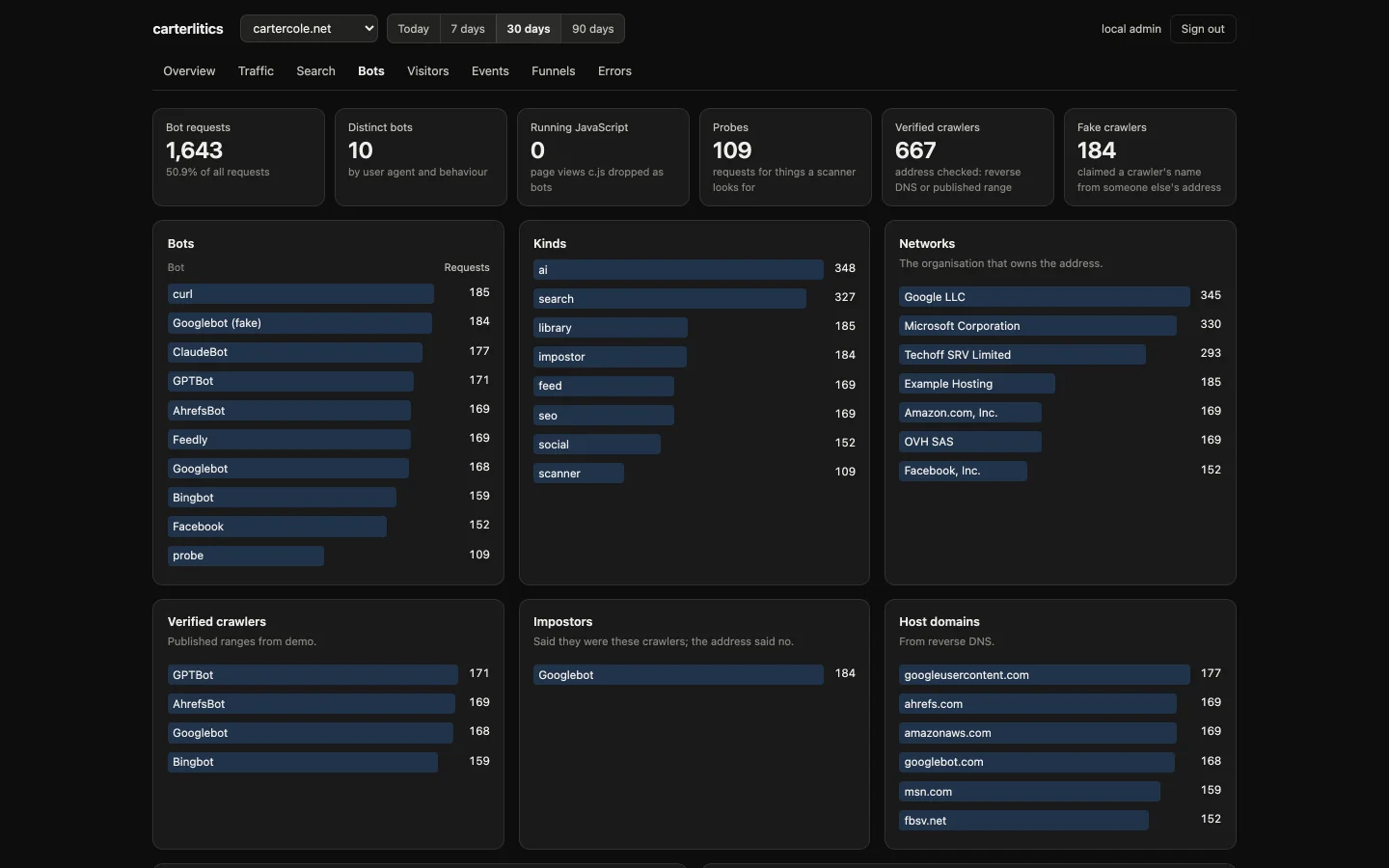 02 The real Googlebot, and the other one
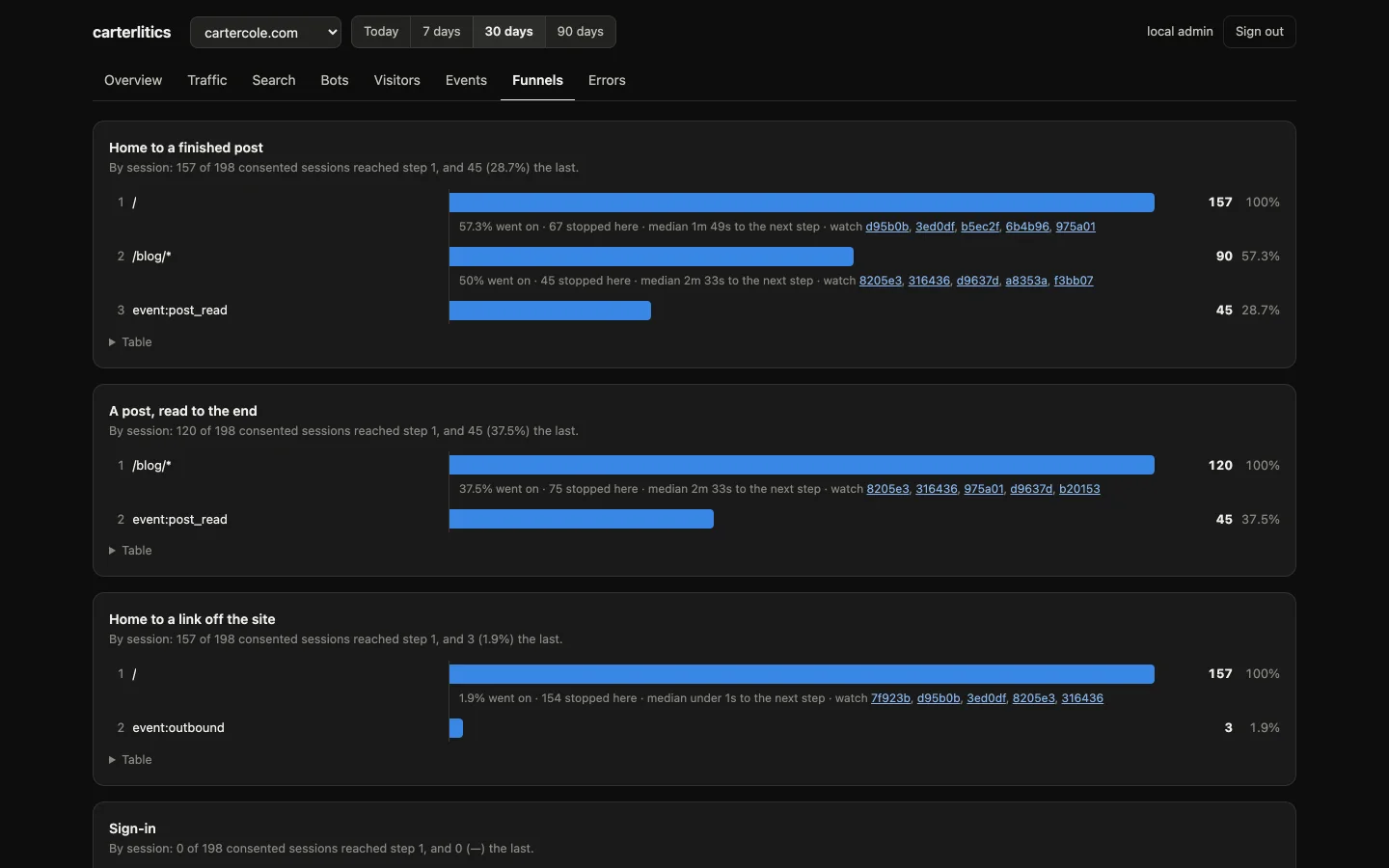 03 Where each funnel loses people
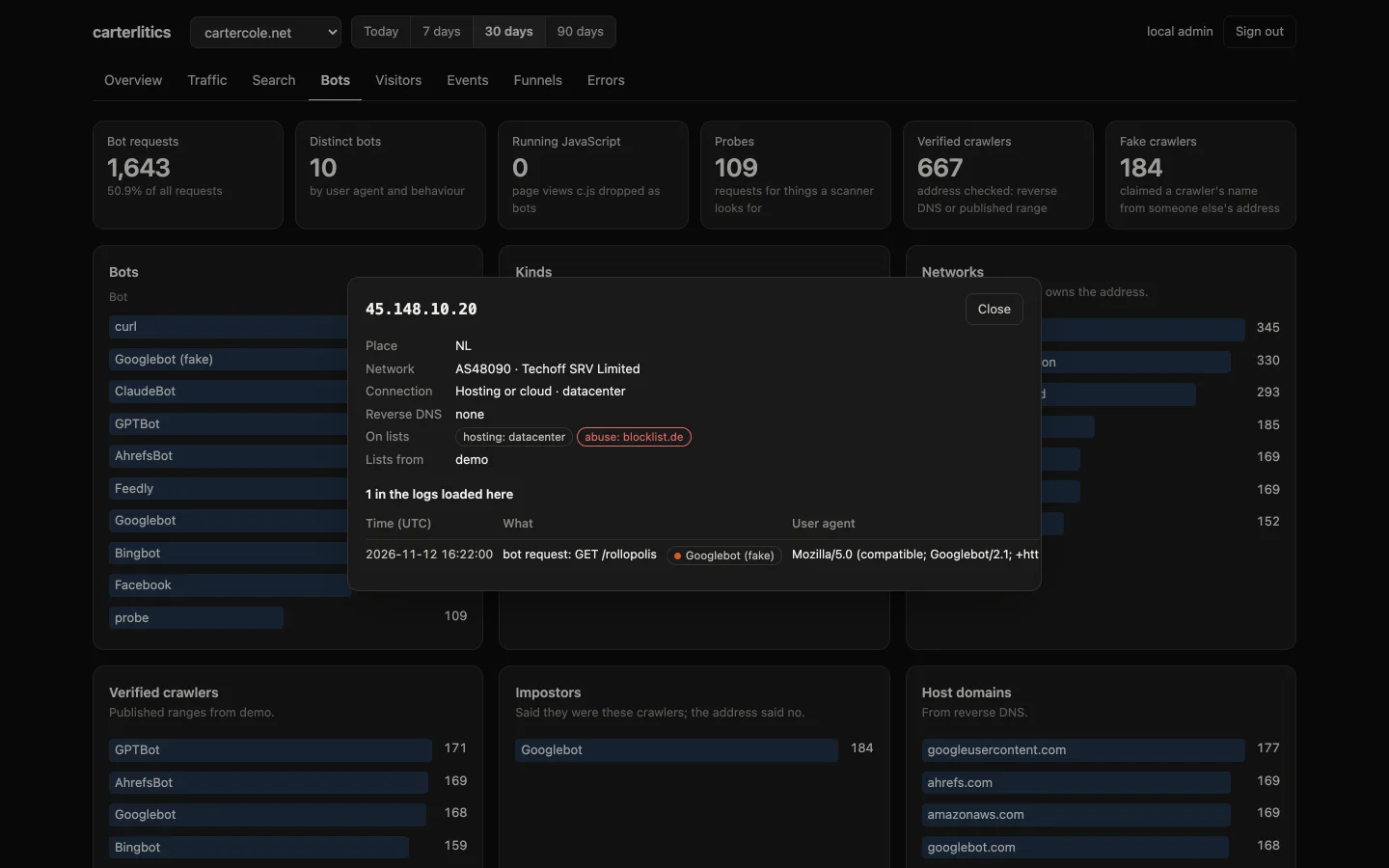 04 Says Googlebot; the address disagrees
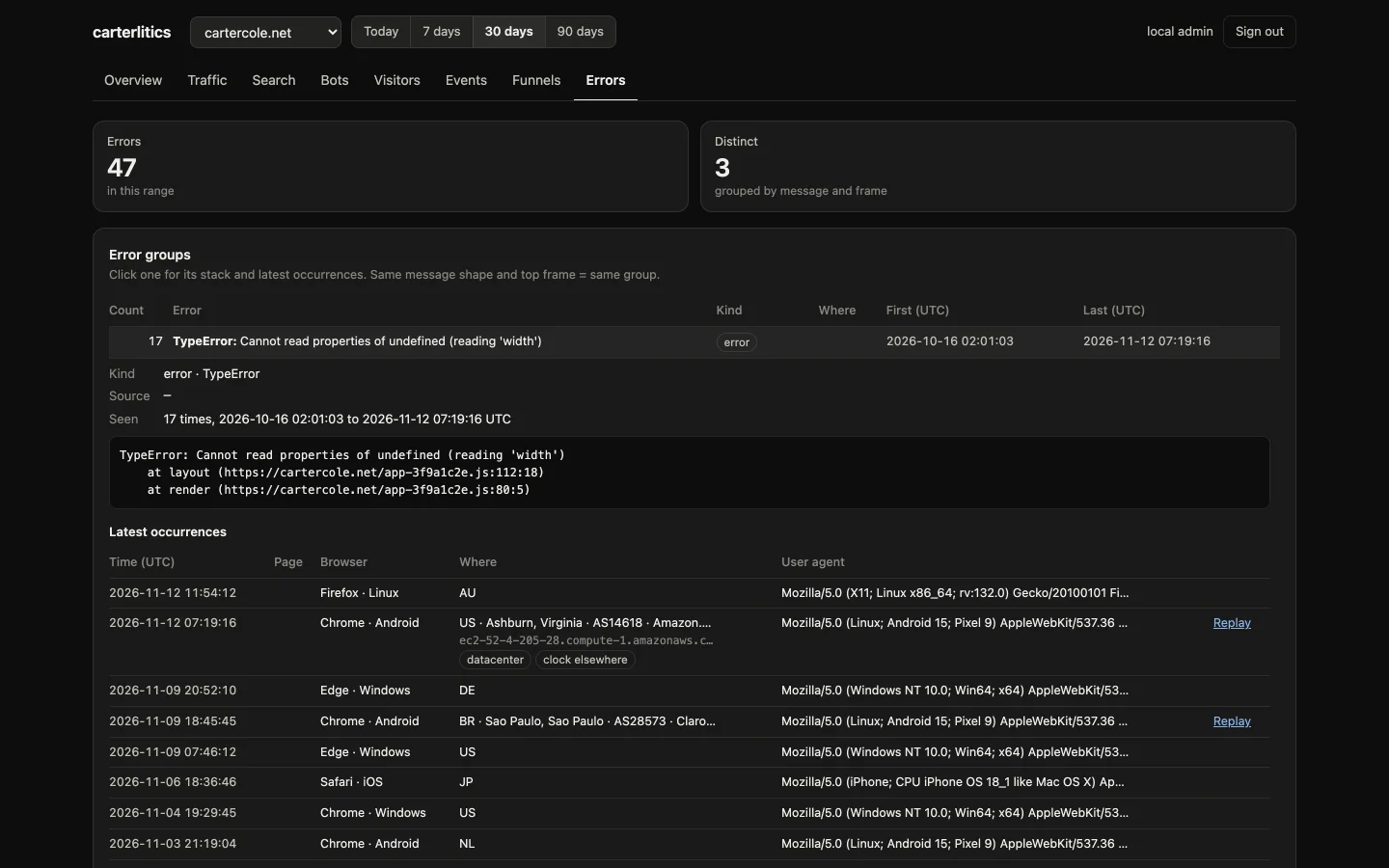 05 Forty-seven errors, three bugs
Two sources, one count
The server side sees everything, cache hits included, because CloudFront delivers its access logs to the collector: address, user agent, path, status, referrer, country and network. The client side, /_c/c.js, adds what only a browser knows: engaged time, single-page navigations, where a visit came from, custom events, and errors (uncaught exceptions, unhandled rejections, failed resources and CSP violations), grouped by bug. A page written for Google Analytics works unchanged, since gtag(), dataLayer.push(), ga() and _gaq.push() are all understood.
Every site routes /_c/* to the same Lambda through its own CloudFront distribution, so all of it is first-party. The cookies are the site's, CloudFront supplies the real viewer address, and blockers aimed at third-party analytics hosts have nothing to block. On the way in, CloudFront adds a shared secret and the site's ID as headers and overwrites any header of the same name a viewer sent, so neither can be forged.
Unique without a cookie
A unique visitor is sha256(daily salt, site, address, user agent). The salt is random and deleted after two days, so once it's gone a hash can't be traced back to anyone. Visits, bounces, landing pages and exit pages are counted on the collector from the same hash as they happen, so the numbers cover everyone who hasn't opted out, whether they consented or not. Do Not Track and Global Privacy Control count as opting out.
What an address is
Every address the collector keeps is classified without being sent to a lookup service: reverse DNS from AWS's own resolver, and one binary search over about thirty published lists. Those lists cover the ranges Google, Bing, OpenAI, Apple and others crawl from, the big clouds, iCloud Private Relay's egress, Tor exits, VPN providers, Starlink, Spamhaus DROP, and addresses seen attacking in the last few days. Each search takes about four microseconds. A request that says it's Googlebot is checked against Google's published ranges and forward-confirmed DNS, and one that fails is counted as "Googlebot (fake)".
With consent
A visitor who clicks Accept gets a visitor cookie, a session per tab, and an rrweb recording the console can replay. Inputs are masked, and anything marked [data-private] is never recorded. Funnels count steps in order over those sessions, with the drop-off at each step and replays of the sessions that stopped. What is collected, and for how long has a page of its own.
The console
One console at /_c/admin/ covers every site: overview, traffic, Google Search, bots, visitors, events, funnels, errors and replays. Search Console is read through a Google service account that the collector reaches with no stored key. Sign-in is OpenID Connect through Kith, and only admins get a session.
Stated honestly
Cookieless uniques are an estimate. A visit ends at midnight UTC, when the salt changes, and whenever the visitor's address changes, so one person whose phone leaves Wi-Fi counts twice. The GeoLite2 databases it reads are licensed and are not in the repository.
About these pictures
figures/carterlitics.sh in this site's repository draws all five from the console itself, served by carterlitics' own dev server running its demo: 30 days of generated traffic, with made-up visitors, crawlers, an impostor Googlebot, scanners and errors, fed through the same storage code the Lambda uses. None of the numbers are this site's real ones. The demo is laid out relative to the day it runs, so a rerun can move a digit. The run stays offline: the address panel is told not to ask the registry, which would send the address to ARIN and show a real holder.
The tour is filmed from the same console, a real pointer in headless Chrome, once as a desktop window and once at a phone's width for a vertical cut. Its log lines and its visitor are made up for it, from the addresses set aside for documentation, and run through carterlitics' own log reader, classifier and visitor hash; the two requests from c.js are what it sent from a page that loaded it through the dev server. The voice is Orpheus, run locally.