// 02 FIELD TOOLS
1fold
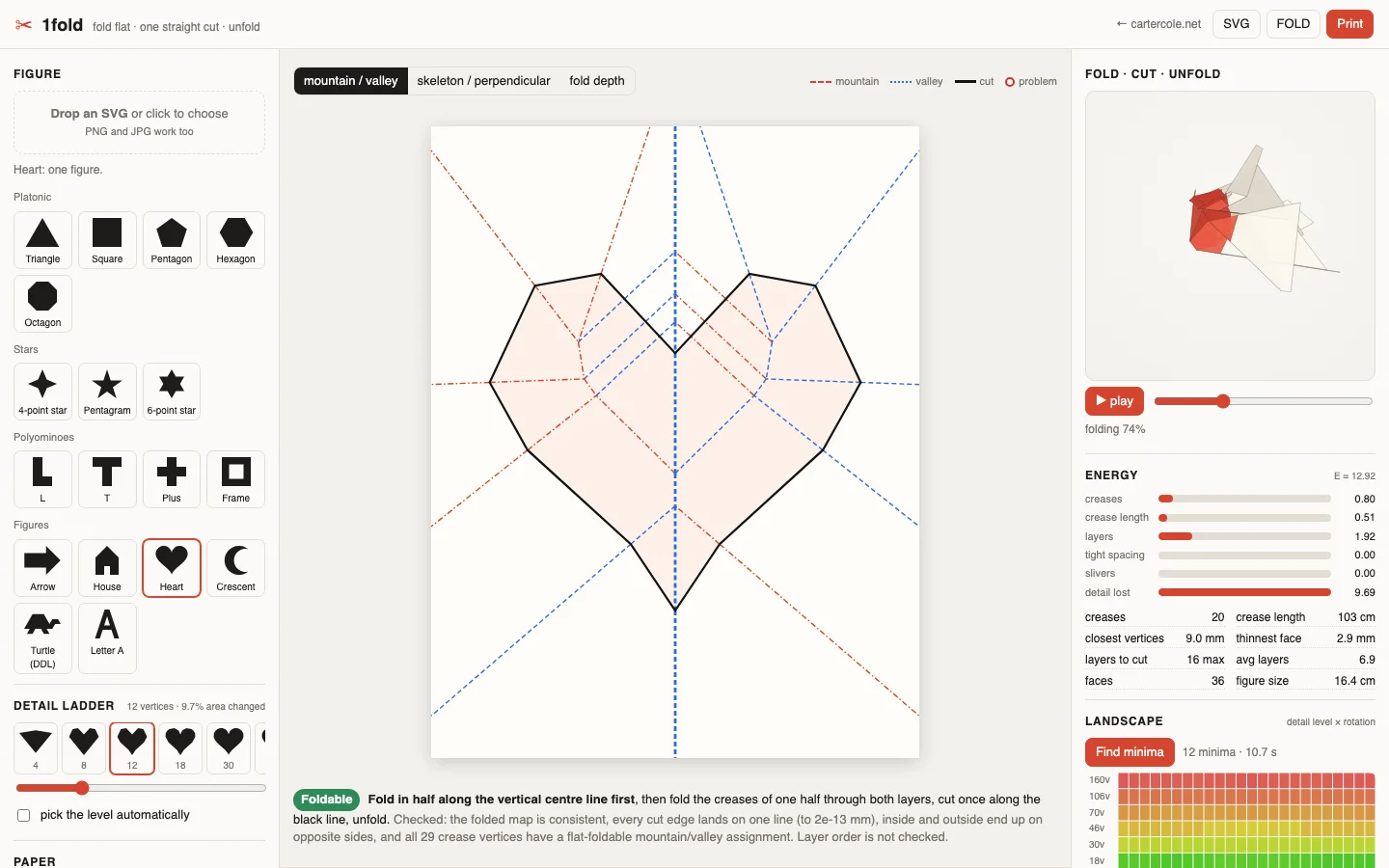
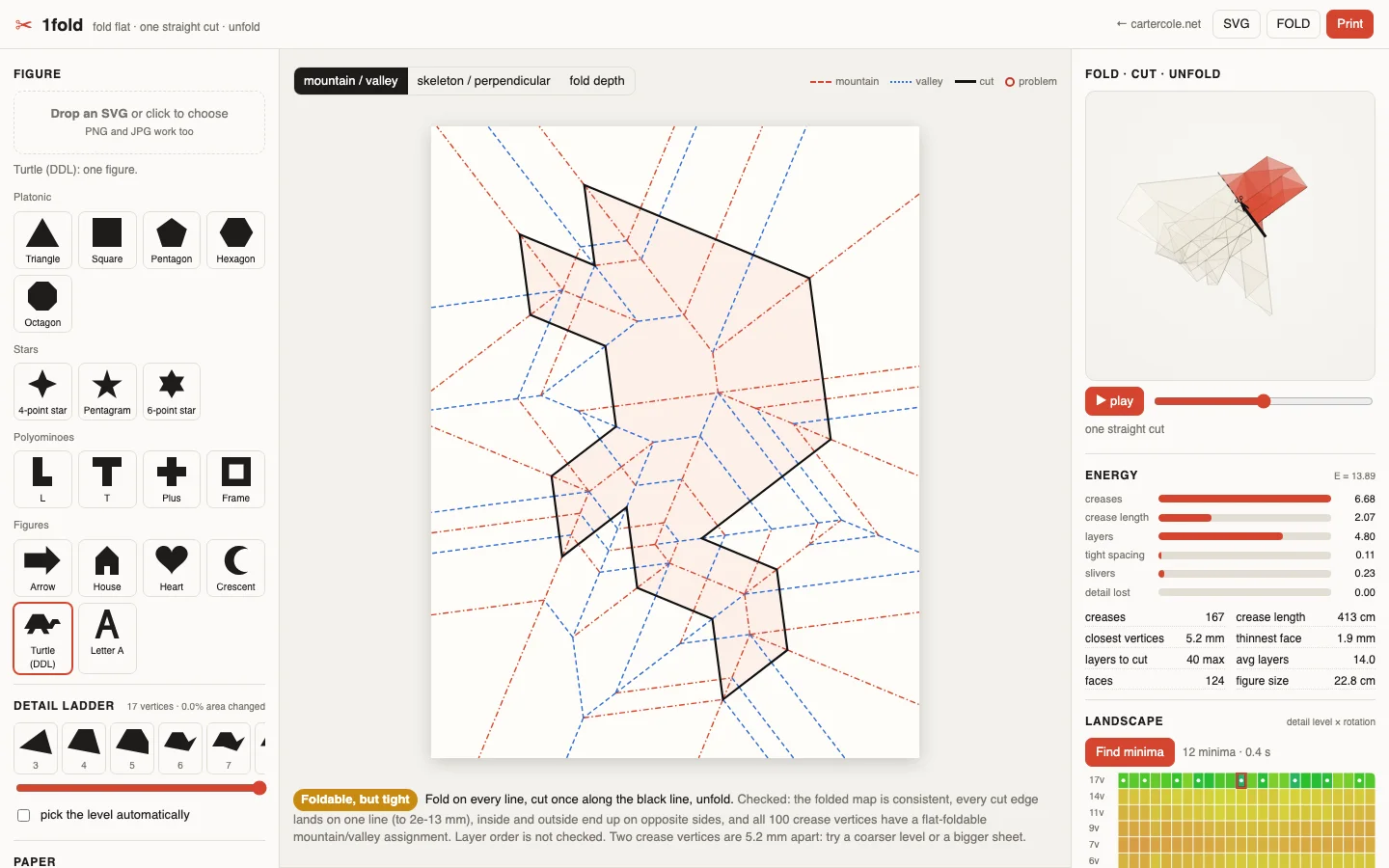
Upload an SVG and get a sheet of creases: fold on every line, make one straight cut, unfold, and the figure falls out. 1fold scales the drawing to a printer page, checks it is one connected figure, simplifies it into a ladder of detail levels, and finds the patterns that are easiest to fold by hand. Every pattern it shows has been folded in software first. Drag the figure and the creases follow in real time; play the fold, the cut and the unfold in 3D; print at true scale or export FOLD for Origami Simulator.
How it works
It is the straight-skeleton method from Demaine, Demaine and Lubiw's 1998 paper. The figure's outline shrinks inward and grows outward at unit speed, and the skeleton those wavefronts trace is the first set of creases. Perpendiculars from the skeleton's vertices are the second set. They bend each time they cross a skeleton edge, so that every edge of the outline folds onto one line. Simultaneous events are clustered exactly rather than jittered, so a square, a regular pentagon or a pentagram comes out as the clean pattern you would draw by hand.
To check a pattern, 1fold folds it in software. It composes reflections face by face, then confirms that the map is consistent, that every cut edge lands on one line, and that inside and outside end up on opposite sides. Mountains and valleys are then assigned and repaired until every crease vertex can fold flat. A figure with a mirror line is folded in half first, and only one half is solved. That makes three to four times fewer creases: a T in 12 instead of 46.
Candidates
The energy estimates the work for a person with paper. It weighs crease count and length, the layers the scissors must get through, crease vertices closer than 6 mm, thin slivers, and the detail lost to simplification. A scan in a Web Worker tries every detail level at every rotation, with several choices of which perpendiculars to fold. It keeps the distinct local minima: the lowest is the canonical pattern, and the rest are alternatives you can pick from the heatmap or the gallery.
Stated honestly
Layer order is not checked, so a pattern can be locally flat-foldable yet need the paper to pass through itself. None of the patterns has been folded on real paper yet. Curvy outlines need a great many creases past a dozen or so vertices, so their best patterns are coarse; that is what folding by hand allows. The 3D preview moves rigid panels between the flat states, and only the fully folded state is exact. It is one self-contained page in plain JavaScript that runs entirely in your browser and is laid out for a desktop window. The source is not under version control, so there is no repository to link.